The AI wave enters a diffusion phase: opportunities in Chinese ADRs and semiconductors amid global asset rebalancing
Keywords: emerging market allocation, artificial intelligence, semiconductors, DRAM, Chinese ADRs, Hong Kong stocks, capital flows, tech divergence, asset rotation
Introduction
Global capital markets are going through a clear structural shift. Over the past year or so, artificial intelligence has almost been the sole driver of U.S. stock gains, but as valuation divergence widens, capital flows change, and industrial capital continues to ramp up investment, the market is moving from a phase of "a few AI winners dancing alone" to a new stage in which a broader range of sectors benefit. Recent views from several Wall Street institutions have not only highlighted the internal split between hot and cold areas within tech, but also opened a new window into Chinese assets, the semiconductor chain, and Hong Kong stock rotation.
From an asset allocation perspective, this is not simply a matter of "technology stocks rising or falling," but the result of global liquidity, industry trends, and valuation frameworks acting together. For investors, understanding where capital is flowing, which industries still have fundamental support, and which markets may absorb spillover gains is more important than chasing short-term volatility.
1. Wall Street begins to re-evaluate emerging markets, and Chinese assets may benefit
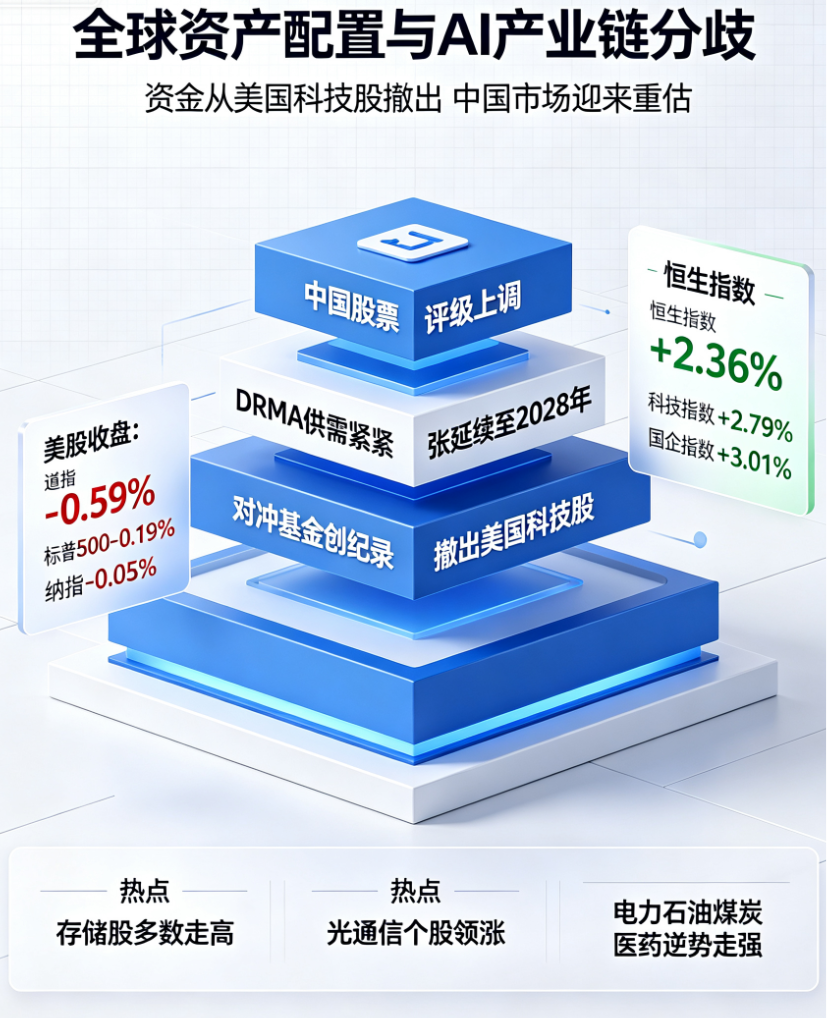
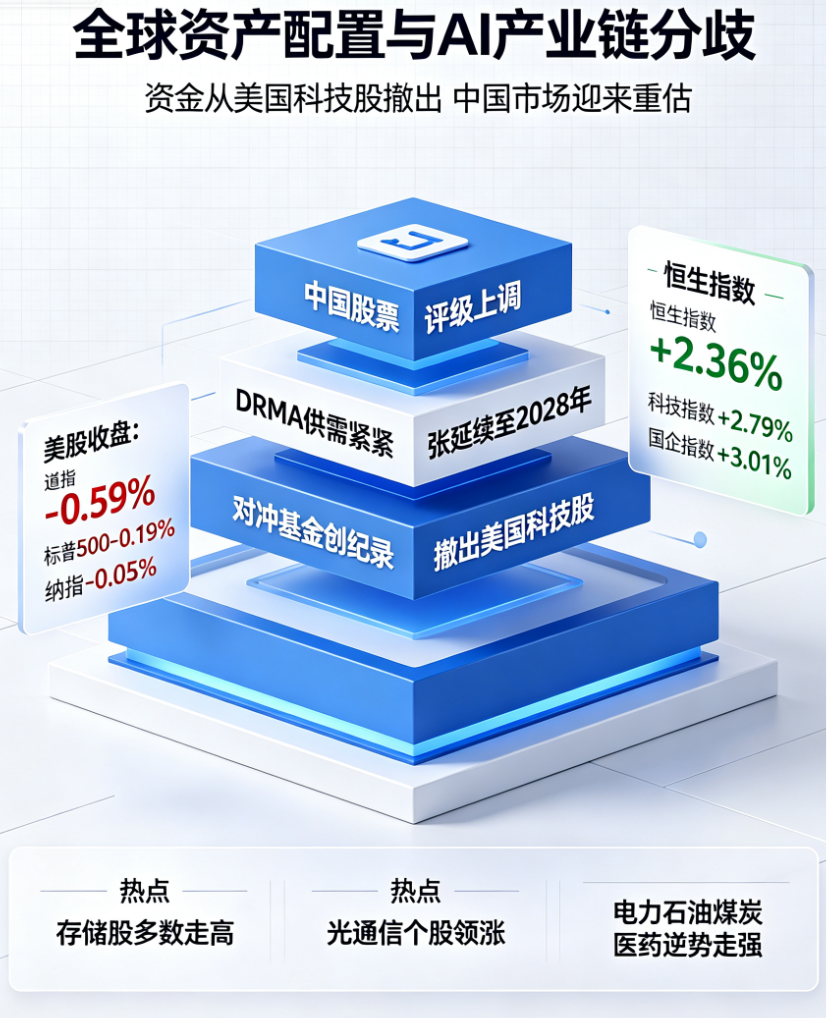
Citi lowered its rating on South Korean equities while upgrading Chinese equities in its emerging market asset allocation, a move that carries strong signaling value. The South Korean market had previously benefited from the strong performance of the memory-chip cycle and the AI compute chain, but after crowded positioning rose and valuations rebounded quickly, short-term value started to decline. By contrast, after a long period of adjustment, the Chinese market is at relatively low valuations, while policy expectations, liquidity conditions, and room for earnings recovery are all gradually improving.
More importantly, Citi believes the rally dominated by a small number of artificial intelligence winners this year is likely to broaden into a wider range of sectors. In other words, AI is no longer just a solo performance by giants such as Nvidia, Microsoft, and Meta; it is gradually spilling over into cloud computing, software services, industrial digitalization, compute infrastructure, and related consumer and application chains. If this trend continues, Chinese internet platforms, AI applications, compute-supporting businesses, and high-dividend assets may all benefit from improved risk appetite.
For Hong Kong stocks and A-shares, this means the market pricing logic may shift from "whether there is AI" to "who can truly deliver earnings." As investors begin looking for names with better upside potential and more reasonable valuations, the appeal of Chinese assets in allocation will be amplified again.
2. Chip stocks are diverging from fundamentals; Q2 earnings season may be the key catalyst
JPMorgan pointed out that the recent decline in chip stocks has become increasingly disconnected from fundamentals, and recommended increasing exposure during the summer. Behind this view lies the most important line in the semiconductor industry: AI demand has not weakened; instead, it continues to tighten upstream supply and demand.
Particularly noteworthy is JPMorgan's expectation that, driven by AI, DRAM supply-demand tightness will last through 2028. This implies that the memory cycle is no longer a traditional short-cycle fluctuation, but has been reshaped by AI servers, data center expansion, and demand for high-bandwidth memory. The old narrative that price increases are "peaking out" may need to give way to a new logic of "demand remaining persistently stronger than expected."
In terms of investment timing, the Q2 earnings season may become an important catalyst for the next leg higher. If chip manufacturers continue to release positive signals on order visibility, capital expenditure guidance, and inventory levels, market concerns about valuations may be offset by upward earnings revisions. By comparison, the recent outflow of short-term funds looks more like sentiment-driven volatility than a reversal of the industry trend.
3. AI infrastructure financing is heating up, and tech capex has entered a new stage
Latest reports show that BlackRock is planning to issue more than $12 billion in bonds to finance Meta's data center campus in El Paso, Texas. The signal from this deal is very clear: AI competition has moved from models and chips into a "capital-intensive era" of compute infrastructure.
In the past, discussions about AI focused more on "who has the strongest model" and "who has enough compute"; now, competition around data centers, power supply, network connectivity, cooling systems, and long-term financing capacity is becoming the key to winning. Debt financing at the $12 billion level essentially shows that tech companies' AI spending is no longer just an internal cash-flow cycle, but is beginning to rely on more mature capital market tools for continued expansion.
This also means that investment opportunities in the AI chain are not limited to software and chips. Areas such as data center construction, energy support, communications links, storage equipment, and construction services will all see sustained demand as the capital expenditure cycle lengthens. For the market, what really matters is not whether AI is still here, but how far AI commercialization and infrastructure build-out can go.
4. Capital is leaving U.S. tech stocks, but that does not mean the tech theme is over
Goldman's prime brokerage division said that hedge funds have withdrawn from U.S. technology stocks at a record pace over the past two months. On the surface, this seems to mean capital has become more cautious toward U.S. tech; but from another angle, it may also be the normal rebalancing after a crowded trade cools down.
When tech stocks remain the market's strongest consensus theme for a long time, any valuation swing, earnings miss, or macro shock can trigger concentrated profit-taking. The point is that capital outflows do not equal a deterioration in fundamentals. Leaders such as Nvidia, Microsoft, and Broadcom are still benefiting from AI capex, while sub-sectors such as memory and optical communications continue to show strong momentum. In other words, the current situation looks more like "divergence at high levels" than "the end of the trend."
From the tape, the three major U.S. indexes closed mixed, with the Dow Jones, S&P 500, and Nasdaq all moving only slightly, reflecting that overall market risk appetite has not worsened materially. The big tech names were split: Microsoft, Alphabet Class C, Amazon, and Broadcom were relatively strong, while Apple and Tesla came under pressure, showing that funds are rotating from high-valuation broad tech into more certain leaders within subsectors.
5. Global market rotation is accelerating, and Chinese concept stocks and Hong Kong stocks are showing relative resilience
In Chinese concept stocks, both the Livermore China Concept Stock Leaders Index and the Nasdaq Golden Dragon China Index rose, while most popular Chinese concept stocks climbed, led by Kingsoft Cloud, Alibaba, Futu Holdings, and JD.com. The stage-level recovery in Chinese assets is not merely driven by external sentiment; it also reflects the market's renewed assessment of the long-term value of China's internet platforms, cloud services, and consumer leaders.
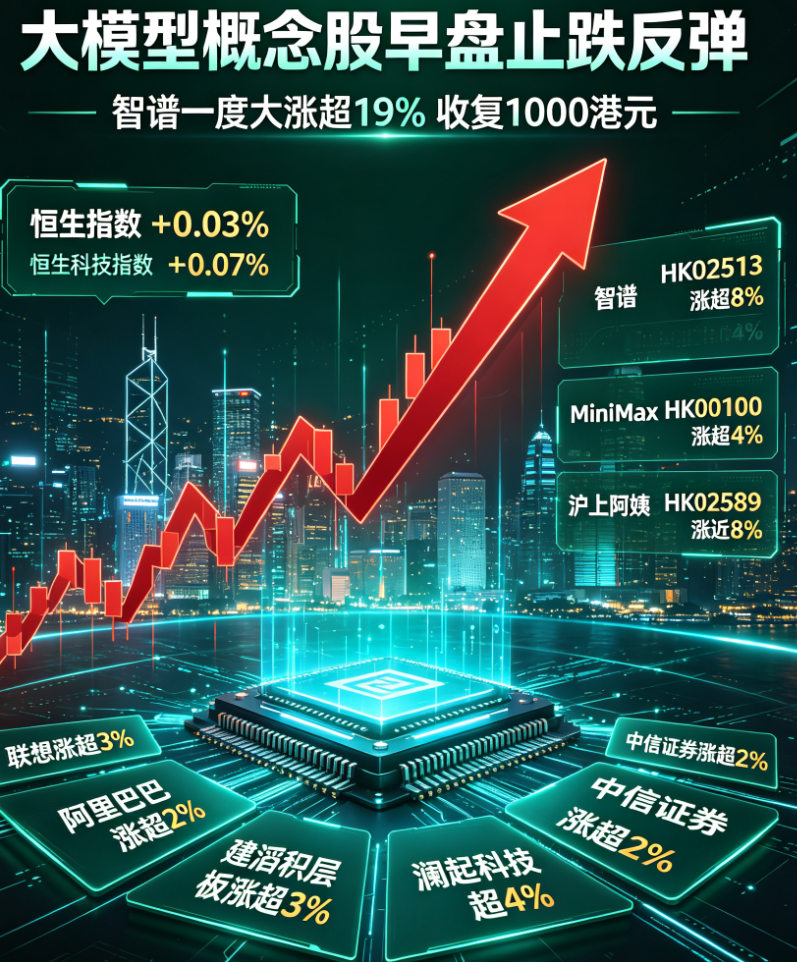
The Hong Kong market also performed strongly. The Hang Seng Index, Hang Seng Tech Index, and the China Enterprises Index all posted sizable gains, showing that risk appetite for Hong Kong stocks is being repaired. However, by sector, electricity, oil, coal, and healthcare-related names moved against the grain and strengthened, while technology stocks such as artificial intelligence, PCB, and semiconductors weakened across the board. This shows that significant rotation is also taking place within Hong Kong stocks: high-beta growth sectors have not taken over broadly, while defensive and resource assets have instead become more favored.
This rotation is not contradictory. It reflects the market's search for a balance between "certainty" and "margin of safety." In the short term, resources, dividends, and healthcare provide defensive characteristics; in the medium term, if the AI diffusion logic continues to strengthen, the tech sector still has a chance to become the main theme again.
Conclusion
Overall, the key features of today's global markets can be summarized in three points: first, the AI rally is spreading from a few leaders to a broader industry chain; second, the fundamentals of chips and memory remain strong, and short-term corrections are more about capital behavior than a reversal of the trend; third, Chinese assets and Hong Kong stocks are in a window of re-pricing, with both valuation recovery and structural rebound opportunities.
For investors, the key in the period ahead is not whether to keep chasing the AI label, but how to identify companies with real earnings delivery capabilities and industry barriers. Over the coming period, global capital markets may move from a "single tech theme" into a new stage where multiple sectors rotate and value and growth coexist. Whoever can capture certainty in this diffusion phase will be more likely to earn excess returns amid volatility.