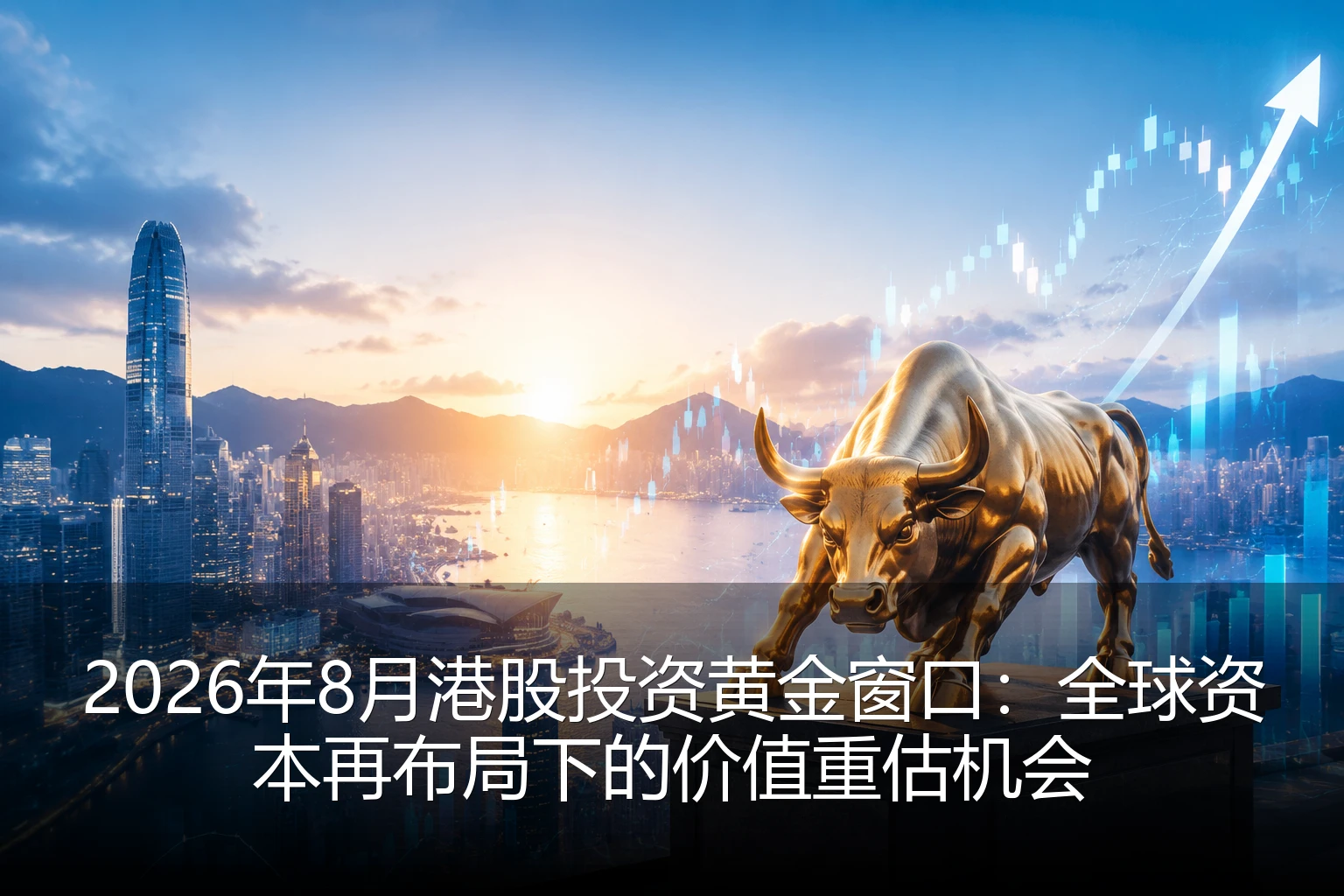
On August 12, 2026, global financial markets are at a subtle turning point. As expectations of the end of the Fed's continuous rate hike cycle fully ferment at the macro level, the US dollar index is quietly weakening, and non-US currencies are generally rebounding. In this grand narrative of global capital reallocation, the Hong Kong stock market is re-entering the core vision of global institutional investors with an unprecedented posture. As a super connector linking the vast economy of mainland China with global capital markets, the HK stock market is demonstrating unique investment value. For domestic investors, understanding this wave of global capital migration and using it to examine the core logic of Why HK Stocks is particularly crucial.
Global Macro Turning Point Confirmed: Foreign Capital Sweeps HK Stocks via Derivatives
Since August, the context of the global macro economy has become clearer. The continuous decline in US inflation data has sharply heightened market expectations that the Fed will start preventive rate cuts in the second half of the year. This shift in expectations directly leads to the confirmation of a cyclical top for the US dollar. Alongside the weaker dollar, the RMB exchange rate has shown a strong appreciation trend recently, which constitutes a major boon for the HK stock market, which is denominated in HKD and centered on RMB assets.
From the monitoring data of capital flows, recent foreign capital is accelerating its return to the HK stock market in a covert and efficient manner. Institutional brokerage business data from multiple international investment banks shows that overseas hedge funds and macro strategy funds are using derivative instruments (such as swap contracts, structured notes, etc.) to aggressively establish long positions in core HK stock assets. This method of sweeping up shares via derivatives reflects, on one hand, a strong consensus among foreign capital on the improvement of Chinese asset fundamentals, and on the other hand, exposes their urgency to grab chips at the bottom.
Why do foreign investors choose HK stocks at this time? The core reason lies in the valuation depression effect of HK stocks. As of now, the forward price-to-earnings ratio (PE) of the Hang Seng Index remains at a low level of around 10 times, which is not only far below the historical average but also at the bottom among major global stock markets. In contrast, the PE of the S&P 500 Index has exceeded 22 times, and even the European market, which has always been regarded as undervalued, has seen its average valuation repaired to over 14 times. Under the Fed's rate cut expectations, global profit-seeking capital will inevitably flow from high-valuation markets to low-valuation, high-elasticity markets, and HK stocks perfectly meet this core demand for capital migration.
Interim Earnings Season Validation: Dual-Driven by High Dividends and Tech Growth
If macro liquidity is the catalyst for the HK stock rebound, then the improvement in micro corporate earnings is the underlying cornerstone supporting the market's strength. The 2026 interim earnings season has entered a dense disclosure period. Judging from the earnings pre-announcements and express reports disclosed so far, the overall earnings performance of HK-listed companies has shown an unexpected trend, especially in the high-dividend and tech growth sectors, forming a dual-driven pattern.
First, traditional high-dividend sectors represented by banks, telecom operators, and energy continue to play the role of a market ballast. Interim reports of several large mainland bank stocks show that their non-performing loan ratios have continued to drop, and net interest margins are stabilizing against the backdrop of a stabilizing macro economy. More importantly, these enterprises generally maintain a dividend payout ratio of over 30%, with dividend yields generally between 6% and 8%. In the macro environment of declining global risk-free interest rates, such assets with highly certain returns have a fatal attraction for foreign capital and southbound funds. Institutional views generally hold that the high-dividend strategy is not only a defensive tool to hedge market volatility, but also an offensive weapon to obtain absolute returns.
On the other hand, the tech growth sector represented by AI computing power and internet giants is also performing brilliantly. With the accelerated commercialization of AI applications, the earnings expectations for HK tech stocks have been significantly revised up. Several leading internet enterprises have demonstrated strong cost-reduction and efficiency-enhancement results in their financial reports, conveying confidence to the market through continuous stock buybacks. At the current stage, the tech sector and the high-dividend sector no longer present a simple seesaw effect, but have formed a resonance. This indicates that the market is shifting from a single defensive stance to an equal emphasis on both defense and offense, and the structural opportunities in the HK stock market are fully blooming.
Continuous Release of Institutional Dividends: Stock Connect and Chapter 18C Reshape the Ecosystem
Discussing Why HK Stocks cannot bypass its continuously evolving market institutions. In recent years, Hong Kong Exchanges and Clearing (HKEX) has spared no effort in institutional innovation, reshaping the ecological foundation of the HK stock market from optimizing listing rules to deepening the mutual market access mechanism.
First, the continuous effect of Stock Connect expansion and southbound capital flow. With the continuous expansion of Shanghai-Hong Kong and Shenzhen-Hong Kong Stock Connect targets, an increasing number of small and mid-cap HK stocks have been included in the mutual market access mechanism. Southbound capital has become one of the indispensable pricing power holders in the HK stock market. For mainland investors, Stock Connect not only provides a convenient channel to allocate high-quality global Chinese assets, but also brings unique AH premium arbitrage opportunities. Currently, the AH premium index is still at a relatively high level, and the price difference between A-shares and H-shares of the same company provides a safety cushion for cross-market arbitrage. The southbound capital flow not only brings incremental funds, but also brings mainland investors' deeper understanding of local enterprises, helping to correct some wrongly killed valuations in HK stocks.
Second, the normalization of trading in severe weather and liquidity reshaping. The severe weather trading rules officially implemented by HKEX earlier ended the traditional market suspension in Hong Kong during extreme weather such as typhoons. This seemingly minor adjustment in trading hours has substantially enhanced the liquidity and continuity of the HK stock market, making it unnecessary for global institutional investors to reserve additional hedging costs for abnormal market suspensions in risk management. This marks a further alignment of the HK stock market with mature markets at the infrastructure level.
Third, Chapter 18C rules and the listing boom of specialized technology companies. For specialized tech companies in next-generation information technology, advanced hardware, etc., HKEX has opened a brand-new channel. This institutional dividend is attracting a large number of unprofitable but highly growth-oriented hard-tech enterprises to list in Hong Kong. This has greatly enriched the tech presence of the HK stock market, providing investors with a valuable entry point to share the dividends of China's cutting-edge technological development.
Multi-dimensional Analysis: Why Choose the Hong Kong Market Now?
Comprehensively analyzing the three dimensions of macro, micro, and institutions, the Duogu GP intelligence platform believes that choosing to invest in HK stocks at this point in time possesses three major advantages: right time, right place, and right people.
Right Time: Reversal of the Global Liquidity Cycle
The rekindled expectations of Fed rate cuts and the weaker US dollar have directly enhanced the attractiveness of emerging markets. As an offshore market, Hong Kong's linked exchange rate system ensures the peg of the HKD to the USD. In the Fed's rate cut cycle, the Hong Kong Monetary Authority will synchronously lower its base rate. This means that the liquidity of the Hong Kong market will directly benefit from global monetary easing, and the decline in local capital costs will push up the valuation center of risk assets.
Right Place: Resonance of Valuation Depression and Earnings Cycle
HK stocks are currently at the resonance point of a valuation bottom and an upward earnings cycle. The unexpected interim earnings results prove the resilience of the Chinese economy, while the extremely low valuation level provides investors with a very high margin of safety. Whether value investors seeking absolute returns or growth stock investors seeking elasticity, they can find matching targets in the current HK stock market.
Right People: Two-way Convergence of Mainland and Overseas Capital
In the past, the HK stock market was often criticized for insufficient liquidity and extreme volatility caused by foreign capital dominance. Today, with the deep participation of southbound funds, the investor structure of the HK stock market is undergoing a qualitative change. Southbound capital and foreign capital have formed a rare consensus at the current level. Foreign capital values low valuations and exchange rate gains, while domestic capital values the scarcity of core assets and arbitrage space. This two-way convergence has laid a solid capital foundation for a long-term slow bull market in HK stocks.
Investment Strategies and Risk Warnings
Facing the historic opportunity in the current HK stock market, how should investors position themselves? Duogu GP, synthesizing institutional views and market trends, proposes the following strategic suggestions:
- Stick to High-Dividend Core Positions: Allocate high-dividend assets such as banks, energy, and utilities as core positions. In the Fed's rate cut cycle, such assets can not only provide stable cash flow, but also enjoy capital gains from valuation repair. It is recommended to focus on targets with high AH premium ratios and stable dividends.
- Buy AI Computing Power and Tech Leaders on Dips: For tech growth stocks, it is recommended to adopt a strategy of buying on dips. The outbreak of the AI industry chain is still in its early stages, and HK internet leaders have significant advantages in computing power infrastructure and AI applications. Focus on leading enterprises that have fulfilled their interim earnings and are continuously increasing their buyback efforts.
- Seize New Stocks and Specialized Tech Opportunities: Utilizing the institutional dividend brought by the Chapter 18C rules, moderately pay attention to specialized tech new stocks with core technological barriers. However, it should be noted that such enterprises often have high R&D uncertainty and valuation volatility, making them suitable for investors with high risk preferences to bet with small positions.
Of course, investing in HK stocks also requires vigilance against potential risks. On one hand, the shadow of global economic recession still looms; if overseas demand falls more than expected, it will drag down the performance of export-oriented HK enterprises. On the other hand, the complexity of geopolitical games may trigger short-term capital outflows. In addition, although the interim earnings season is generally positive, the risk of individual stock earnings bombs still exists. Investors need to carefully screen to avoid stepping on landmines.
In summary, the Hong Kong stock market in August 2026 is at the intersection of global capital reallocation. Whether from the perspective of institutional advantages, valuation levels, or capital flows and earnings cycles, the answer to Why HK Stocks is already clear. At a time when the market is shaking and grinding its bottom, Duogu GP reminds the vast number of investors to step out of the maze of short-term fluctuations and examine the strategic value of the Hong Kong market with a global perspective. In this wave of capital migration, HK stocks are proving to the world their irreplaceable status as a financial center and their investment value with their unique charm.