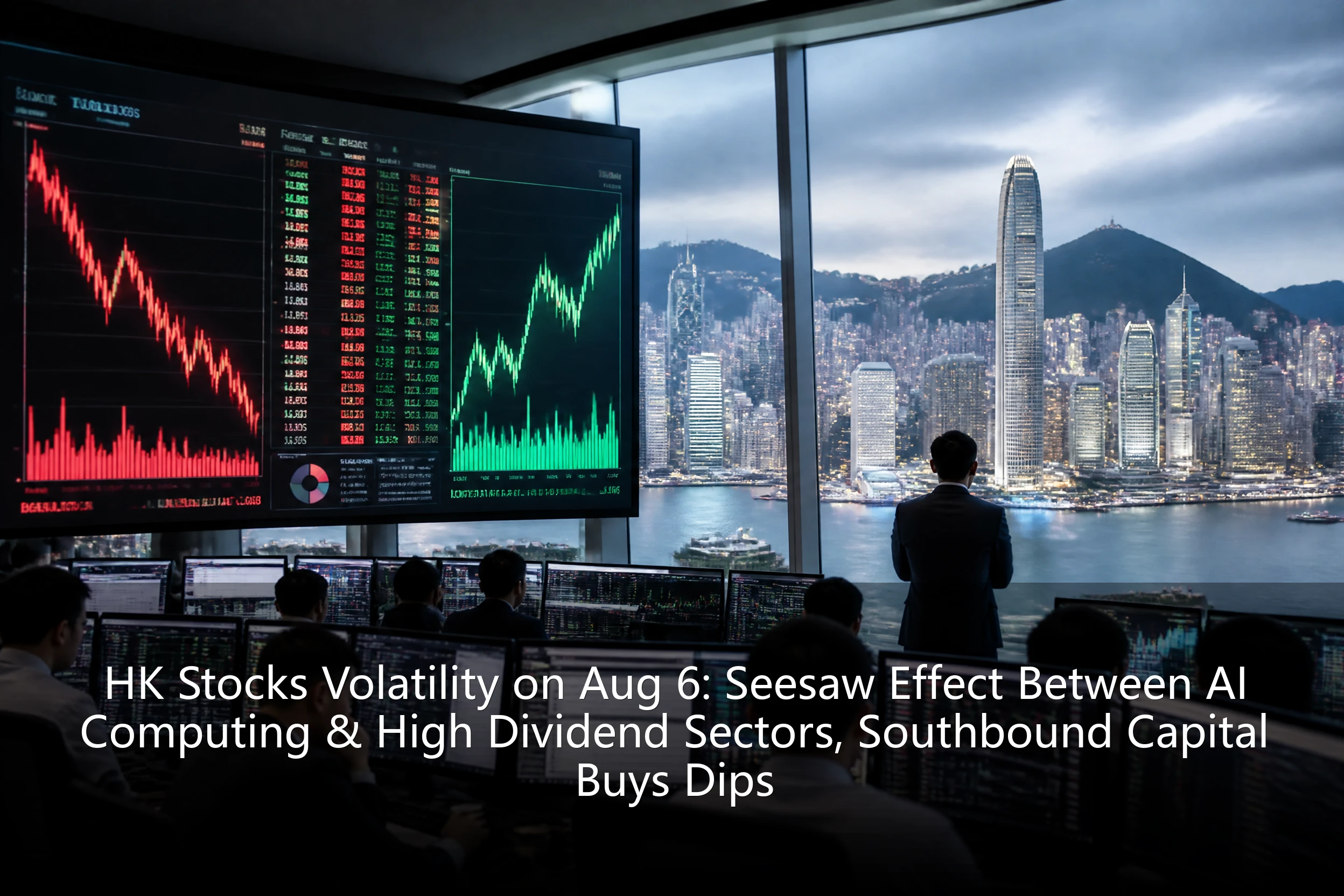
HK Stocks Intraday Briefing Aug 6: Wide Fluctuations, Structural Divergence Deepens
On August 6, 2026, after previous continuous fluctuations, the Hong Kong stock market showed significant wide-range oscillations intraday. The Hang Seng Index opened slightly lower in the morning, then dipped dragged by tech stocks, but found strong support near the 25,000-point integer threshold. In the afternoon, with continuous inflow of southbound capital and stabilization of some financial stocks, the decline narrowed and briefly turned positive. However, overall market sentiment remained cautious, with bulls and bears fiercely competing at current levels.
Looking at intraday performance, the most prominent feature of today's HK market is not a unilateral index trend, but increasingly obvious structural divergence between sectors. Tech growth stocks represented by AI computing and high dividend sectors represented by energy and banks showed a significant "seesaw effect" intraday. When tech stocks weakened due to profit-taking, dividend sectors often strengthened against the market, and vice versa. This divergence reflects not only current funds' safe-haven demands under macro uncertainty, but also reveals the market's complex game regarding China's economic recovery pace and global liquidity expectation changes.
AI Computing Concept Rises Then Falls, Faces Short-term Profit-taking Pressure
Recently hot AI computing concept stocks showed obvious rise-then-fall moves intraday today. In early morning, boosted by overnight new highs of US semiconductor giants like Nvidia, related HK concept stocks quickly rallied. However, due to large short-term gains, some institutional investors chose to cash out at high levels. In the afternoon, multiple leading AI server and optical module concept stocks saw narrowed gains or even turned down.
Regarding this anomaly, industry analysts point out that as one of the most deterministic industry trends in 2026, AI computing's long-term logic remains unchanged. With exponential growth in large model training and inference demand, upstream computing infrastructure orders remain full. However, continuous stock price increases also require gradual fundamental realization to digest valuations. Current valuations of some AI concept stocks are at historical highs, and short-term technical pullbacks are normal market phenomena. Investors are advised to focus more on core tech barriers and actual order fulfillment when investing in AI computing, avoiding chasing highs blindly.
High Dividend Strategy Shows Defensive Value Again, Coal & Bank Sectors Attract Funds Against Trend
In sharp contrast to AI computing's volatility, high dividend sectors showed strong defensive attributes intraday today. Against the backdrop of rising safe-haven sentiment, traditional high dividend industries like coal, power, and banks regained favor, strengthening against the trend. Among them, some leading coal companies' stock prices hit new stage highs.
The high dividend strategy continues to work in the 2026 HK market, backed by profound macro backgrounds. On one hand, under uneven global macro recovery and lingering geopolitical risks, funds' safe-haven demand remains high; on the other, the HK market has many central and state-owned enterprises with abundant cash flow, stable dividends, and high yields. With deepening SOE reforms and market value management assessments, these enterprises' willingness to increase dividend ratios and buybacks strengthens. Additionally, recent declines in risk-free rates further highlight the allocation value of high dividend assets. For long-term funds seeking stable returns like insurance and pension funds, HK high dividend sectors remain rare "safe havens."
Southbound Capital Continues Buying, Acts as Market "Stabilizer"
Today's southbound capital flow remains a market focus. Post-market data shows southbound capital's net purchase exceeded 10 billion HKD, maintaining net inflow for consecutive trading days. Regarding specific flows, southbound capital still prefers a "barbell" strategy: heavily buying internet tech giants like Tencent and Alibaba, while continuously adding positions in high dividend blue chips like banks and telecom operators.
The continuous influx of southbound capital not only provides ample liquidity for the HK market, but largely offsets outflow pressure from foreign capital due to global macro volatility. In recent years, with the continuous improvement and expansion of Stock Connect, mainland capital's influence on the HK market grows. Southbound capital has become an indispensable "stabilizer" for the HK market. This change in capital structure shifts HK market pricing power toward mainland capital, and its valuation system may be reshaped accordingly.
Technical Analysis & Outlook: Watch Key Support and Interim Results Realization
From a technical analysis perspective, the Hang Seng Index is currently oscillating within a 25,000-26,000 range. As an important psychological threshold and technical support, 25,000 points has withstood bear tests multiple times recently, showing strong support. Above, near 26,000 points, many trapped positions accumulate, requiring larger volume for short-term breakthroughs. The MACD indicator hovers near the zero axis, with relatively balanced bullish and bearish forces; the short-term market may maintain a consolidation pattern.
Looking ahead, investors need to focus on the following factors. First is the upcoming intensive disclosure period for HK interim results. After previous concept speculation, the market enters a performance verification period. Industries and stocks that can realize or beat expectations may stand out in volatility, while concept stocks missing expectations face greater pullback pressure. Second is the Fed's monetary policy direction. Although the global rate cut cycle has begun, the Fed's pace and magnitude remain uncertain, directly affecting foreign capital flows. Finally, the implementation effect of domestic growth-stabilizing policies is also a key variable affecting HK market sentiment.
Investment Strategy: Balanced Allocation, Seize Structural Opportunities
Given the current market environment, investors are advised to adopt a balanced allocation strategy, finding equilibrium between defense and offense. Specifically:
- Stick to high dividend base positions: Against lingering macro uncertainty, high dividend strategies still offer high win rates. Continue allocating quality blue chips with dividend yields above 6% in banking, energy, and utilities as portfolio "ballast."
- Buy AI computing on dips: For tech growth sectors like AI computing, avoid chasing highs and patiently wait for pullback buying opportunities. Focus on sub-sector leaders with core tech, high order certainty, and reasonable valuations.
- Watch consumption recovery theme: As domestic consumption stimulus policies gradually land, some consumer stocks with historically low valuations and marginally improving fundamentals deserve attention on dips.
In summary, while the current HK market faces some volatility pressure, downside space is relatively limited under continuous southbound capital support and the valuation trough effect. Investors should remain patient, use market volatility to optimize holdings, seize structural opportunities, and wait for the market to break out of the consolidation range.