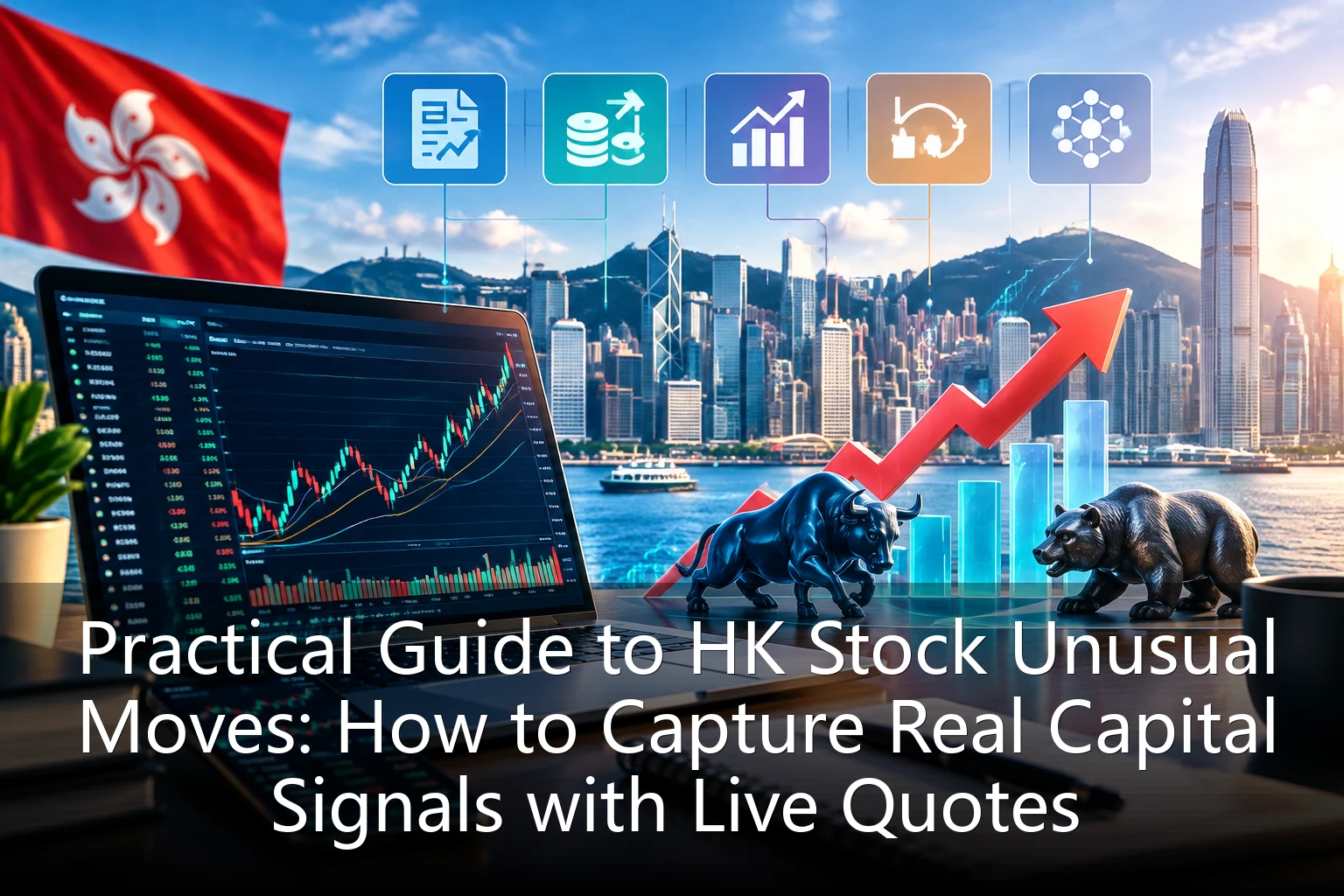
Among the world's major markets, Hong Kong stocks are known for their high volatility. There is no price limit system here, T+0 intraday trading is supported, short selling is well established, and institutional funds compete alongside retail investors, making unusual stock moves far more frequent and dramatic than in other Asian markets. For investors used to the trading pace of A-shares, HK movement signals are steep and abrupt—both opportunity and risk. Starting from the causes of unusual moves and combined with live quote tools, this article breaks down a practical filtering and pitfall-avoidance method to help investors reduce blind chasing and avoid traps in chaotic sessions.
Where Do HK Stock Unusual Moves Come From? Five Trigger Types
An unusual move typically refers to a stock's price or volume deviating sharply from its norm within a short time, often accompanied by an abnormal widening of bid-ask spreads and a sudden acceleration in trading pace. To distinguish valid signals from market noise, you must first understand the drivers behind these moves, which commonly fall into five categories:
- Earnings and news driven: Around earnings releases or after announcements of major contracts, acquisitions, restructuring, or buybacks, prices often jump directionally. These moves have the strongest fundamental basis, but beware of profit taking once the good news is fully priced in.
- Southbound and northbound flows: When southbound net buying (Stock Connect) is highly concentrated in one stock, it often fuels a trend lasting several days; phased inflows and outflows of foreign capital can also cause sudden intraday shifts, so watch the persistence and concentration of fund flows.
- Index and rule changes: Periodic reviews of Hang Seng Index constituents, additions and removals of Stock Connect eligible stocks, and margin requirement changes all trigger passive buying and selling by tracking funds, with heavy-volume moves often clustering around effective dates.
- Short covering and short squeezes: Short selling is allowed in HK; when a heavily shorted stock gets a sudden positive catalyst, shorts rushing to close positions can send prices soaring within minutes, creating a squeeze-type move—highly explosive but quick to fade.
- Sector resonance and rumor-driven speculation: After a leading stock surges, laggards in the same sector are often rotated into for catch-up gains; unconfirmed market rumors can also spark short-term hype. These moves have the weakest staying power and warrant extra caution.
The Three-Step Filter: Extracting Valid Signals from Live Quotes
Live quote tools are the first line of defense for spotting unusual moves. Faced with rapidly flashing prices, follow the three-step process below to turn emotional reactions into systematic judgment.
Step 1: Examine the Volume-Price Structure
Volume precedes price, and trading volume is the lie detector of unusual moves. If a stock rises more than 5% intraday with volume clearly expanding versus its 20-day average and stays active after breaking a key level, real capital is likely involved. Conversely, if price climbs on flat or shrinking volume, the rally is largely hollow—limited in duration and prone to fading with long upper shadows. Watching the combination of volume ratio, turnover rate, and intraday trade density reveals capital intent far better than price change alone.
Step 2: Read the Order Book and Bid-Ask Spread
HK quotes provide ten levels of bid and ask queue. A healthy unusual move typically shows persistent large bids at the best price, a gradually narrowing spread, and bids quickly refilling after offers are absorbed. If large sell orders reappear right after being eaten, or price jumps but volume fails to follow, beware of fake-breakout order-book traps. Order-book signals must be cross-checked repeatedly against intraday charts—never take displayed orders at face value.
Step 3: Cross-Verify the Information
When a move appears, immediately check three things: whether the company has filed an announcement on the HKEXnews website, whether sell-side institutions recently adjusted ratings or target prices, and whether peers in the same sector are strengthening in sync. If a stock moves alone with no supporting news and no sector response, the signal's credibility drops sharply—better to miss out than to trust wrongly.
The Risk Side of Unusual Moves: Three Common Traps
Opportunity and risk travel together in HK stock moves; the following three traps occur most often, and investors should develop reflex-like vigilance:
- Pump-and-dump traps: Certain low-priced, small-cap stocks are quickly run up by a small amount of capital to create the illusion of a big rally, luring retail buyers in, followed by dumping and continuous declines. Warning signs include extremely low historical turnover, no substantive announcement before the move, and a very thin order book.
- Liquidity traps: Thinly traded stocks naturally carry wide bid-ask spreads, so both buying and selling incur noticeable slippage. If the trend reverses after you chase in, exiting promptly can be difficult, and paper losses can balloon within minutes.
- Rule misperceptions: T+0 trading in HK does not mean T+0 cash settlement, and the absence of price limits means single-day losses can theoretically far exceed expectations. Position sizing and stop-loss discipline matter even more in HK than in A-shares.
Building Your Own Movement Watchlist: Let Tools Serve Discipline
Efficient monitoring does not rely on staring at screens during the session; it relies on a systematic checklist built in advance. Investors can create watchlist groups by theme (tech and internet, biotech, high dividend, new energy, etc.) and set clear alert conditions for each: volume ratio above a threshold, intraday price change beyond a set percentage, breaks above or below key moving averages, or abnormal changes in southbound shareholding. Once a signal triggers, run it through the three-step filter above and consider action only after confirmation.
Also make good use of live streaming and market commentary services to capture intraday capital flows and leading sector dynamics in real time, combining hard alert conditions with flexible interpretive judgment. On execution, stick to diversification: a single unusual-move trade should not exceed a tolerable share of total capital; preset a stop-loss before entry and execute it unconditionally once triggered. Trading unusual moves is essentially repeated participation in high-probability events, not an all-in gamble on a single opportunity.
Conclusion: Signals Are Windows, Discipline Is the Moat
Unusual moves are windows into market sentiment, letting you see the path of major capital earlier than most; but a signal alone is not profit—an unverified, undisciplined move is more like a carefully laid bait. For HK investors, truly sustainable returns come from a complete loop of signal identification, cross-verification, position management, and stop-loss execution. Rather than envying every sharp spike on the screen, first build a solid watchlist, alert conditions, and trading rules, so every unusual move becomes part of a prepared plan instead of making you a slave to emotion. When you can face flashing quotes with calm, live quotes truly transform from a source of anxiety into a sharp tool for capturing capital signals.